All Products
Up to 338,560 wells/chip
Up to 3 fluorescence channels
>95% recovery rate
Live-cell recovery
Single Cell Hunter provides visual, gentle, and precise single-cell recovery — from fluorescence detection to downstream biology.

What researchers are saying
The system allowed us to visually confirm target cells before recovery, which significantly improved confidence in downstream analysis.
— Antibody Discovery Team, Research Institution
Single Cell Hunter helped simplify rare-cell recovery in workflows where conventional sorting was too harsh or insufficiently selective.
— Translational Research Laboratory
Why It Matters
Gentle Live-Cell Recovery
Recover viable cells with glass-capillary pickup designed to minimize mechanical stress — live and ready for downstream culture, PCR, or sequencing.
Visual Confirmation Before Pickup
Review brightfield and fluorescence images well by well before recovery — not just a signal score, but a real cell image for higher confidence.
Rare-Cell Friendly Workflow
Suitable for precious, low-frequency, and high-value targets. Designed for events you cannot afford to miss or damage.
High-Throughput Screening at Scale
Screen tens of thousands to hundreds of thousands of cells in a single run — with automatic ranking and one-click recovery.
Overview
What is Single Cell Hunter?
Single Cell Hunter is a microchip-based automated instrument for high-throughput single-cell analysis and recovery. The system scans dense microwell chips by brightfield and fluorescence, ranks target cells by signal intensity and location, and then gently recovers selected live cells with a micro-glass capillary.
Unlike conventional bulk sorting approaches, Single Cell Hunter lets researchers review morphology and fluorescence at the single-cell level before pickup. This makes it particularly well suited for antibody-secreting cells, rare positive events, difficult samples, and workflows where cell viability and downstream recovery quality matter as much as detection.
See Single Cell Hunter in action
How It Works
Four steps from sample to recovery
1
Load cells onto the microchip
Labeled or unlabeled cells are seeded onto a high-density microwell chip. A brief centrifugation step positions cells into wells and removes cells outside the wells.
2
Scan and analyze
The instrument captures brightfield and fluorescence images across the chip, measures signal intensity, and generates a ranked list of target candidates based on fluorescence, position, and user-defined criteria.
3
Select target cells
Researchers review images, verify morphology, and choose cells of interest by intensity rank, defined regions, or application-specific criteria — with direct visual confirmation before pickup.
4
Recover live single cells
A micro-glass capillary gently picks and dispenses the selected cell directly into a 96/384-well plate, PCR tube, or strip tube for culture, PCR, cloning, or sequencing preparation.

Why laboratories choose Single Cell Hunter
• See the cell before you pick it — review brightfield and fluorescence images well by well before recovery.
• Recover live single cells gently — glass-capillary aspiration avoids the high-speed mechanical stress of flow sorting.
• Handle rare and valuable events — suitable for low-frequency positive cells, including CTC applications.
• Move from screening to downstream biology — recover cells into 96/384-well plates, PCR tubes, or strip tubes.
Core technology advantages
• High-density microwell chips: available in 10 μm, 20 μm, and 30 μm formats with up to 338,560 wells per chip.
• Three-color fluorescence: supports FITC, PE, APC, CytoRed, and DAPI-class assays.
• Precise single-cell pickup: signal-ranked target cells can be recovered in sequence, randomly, or from defined chip regions.
• Time-lapse compatible analysis: supports kinetic observation of secretion or stimulation responses.
Trusted by teams at leading research institutions and biopharmas







Detection Methods
Built for antibody discovery teams · rare-cell researchers · translational scientists · single-cell genomics labs · core facility managers
Antibody–Antibody Sandwich
Antibody-Coated Well Type
Wells are pre-coated with a capture antibody. Secreted antibodies are captured and detected via a fluorescently labeled secondary antibody. Ideal for quantifying secretion levels and selecting highest-producing clones.
Antigen–Antibody Sandwich
Antigen-Coated Well Type
Wells are pre-coated with the target antigen, selecting only antibodies that specifically bind the antigen of interest. Function-first screening — every recovered clone is validated for true target specificity from day one.
Applications
Built for demanding single-cell workflows
Antibody drug discovery
Single-cell ELISA-based screening for antibody-secreting B cells, hybridomas, or CHO cells, with the ability to identify and recover high-secreting clones.
GPCR-Targeted mAb Screening
Combine plasma cell co-culture with time-lapse reporter readout for GPCR-targeted antibody discovery. The MoGRAA® platform — covered by five patents — links phenotype to genetic sequence.
Rare-cell isolation
Suitable for workflows where positive cells are extremely infrequent. Visual confirmation before recovery improves confidence for CTC-class and other rare-event applications.
Single-cell genomics
Recovery of selected single cells for downstream RNA-seq, genetic analysis, or targeted sequencing workflows requiring high cell viability and recovery quality.
Cell line development
Useful for selecting clones with favorable secretion, growth, morphology, or reporter behavior; supports iPS workflow applications.
Microbiology and specialized targets
Published materials indicate use in yeast, bacteria, iPS-derived cells, receptor screening, and specialized functional assays requiring live cell recovery.
Credibility
Backed by Research and Real-World Applications
Peer-Reviewed Research
Supported by published work in single-cell analysis, functional screening, and high-throughput live-cell recovery validation.
Recognized Innovation
Award-winning microchip-based single-cell platform. Recognized for manufacturing and innovation excellence — 5th Monodzukuri Nippon Grand Award, METI Minister Prize.
Application Breadth
Used across antibody discovery, rare-cell recovery, single-cell genomics preparation, microbiology screening, and core facility workflows.
Application NOTE: Antibody Discovery
Single-cell antibody PCR — 46-cell validation panel
Single Cell Hunter was used to isolate 46 individual B cells. RT-PCR successfully amplified both heavy and light chain antibody genes, demonstrating high single-cell recovery quality and downstream compatibility for full antibody validation workflows.
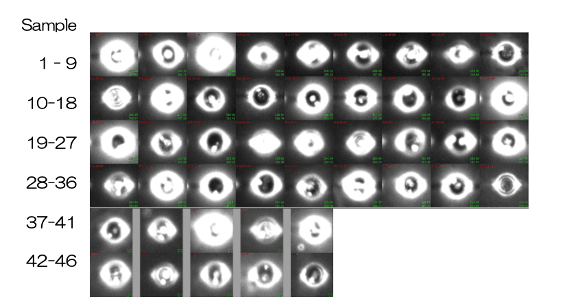

RT-PCR amplification of heavy and light chain antibody genes from 46 individually isolated single B cells. High amplification rate confirms efficient single-cell recovery and lysis.
Key Performance
Data-driven performance
• Microwell density up to 338,560 wells per chip (10 μm format); 20 μm and 30 μm formats also available.
• Whole-chip scan time of approximately 20 minutes under standard conditions.
• Fluorescent bead pickup rate reported at greater than 95% under stated test conditions.
• In a validated antibody-discovery example: 500 antigen-specific B cells detected from 1.5 × 10⁵ lymphocytes; 46 high-secreting cells recovered; 41 of 46 samples (89%) yielded antibody gene amplification; 37 of 41 expressed antibodies showed specific antigen binding (~90%).
• In a CHO screening example: 3,252 single cells detected automatically; 24 strong secretors isolated; 2 higher-producing clones selected for production evaluation.
Compatible with standard downstream molecular workflows — exportable image and analysis data for PCR, sequencing, further cell culture, and documentation.
Competitive Comparison
Why Single Cell Hunter stands apart
The five decisive differences — why researchers choose Single Cell Hunter.
Single Cell Hunter
✓
Visual confirmation before every recovery
✓
Gentle glass-capillary pickup — live cells delivered
✓
Built for rare-event and low-frequency targets
✓
High-density microwell screening — up to 338,560 wells
✓
Simple four-step workflow: Load → Scan → Select → Recover
Conventional Sorting Methods
✗
Signal gating only — no direct image review before recovery
✗
High-speed sorting can stress or damage fragile cells
✗
Variable confidence for rare positive event recovery
✗
Throughput limited by sample prep and instrument setup
✗
Higher complexity setup — specialist training often required
From Boston
U.S. Support and Scientific Engagement
For research teams in North America — we are here for demos, workflow discussions, and application support.
Greater Boston Innovation Ecosystem
Based in the Greater Boston life science corridor, close to leading research hospitals, biotech companies, and universities.
Support for North American Research Teams
Direct support for U.S. and Canadian research teams, including application review, protocol guidance, and instrument access discussion.
Scientific Discussion Available
Scientific consultation available for workflow fit review, application assessment, and assay compatibility discussion.
Demos, Protocols, and Collaboration
Contact us for demos, protocol discussions, application development support, and collaboration opportunities.
Technical specifications
Parameter
Single Cell Hunter
Microwell chip formats
10 μm (338,560 wells), 20 μm (196,000 wells), 30 μm (84,640 wells)
Detection mode
Brightfield plus fluorescence
Fluorescence channels
Up to 3 colors (FITC, PE, APC, CytoRed, DAPI-class)
Typical scan time
Approx. 20 minutes per whole chip
Recovery method
Micro-glass capillary pickup
Recovery output formats
96-well plate, 384-well plate, PCR tubes, 8/12-tube strips
Instrument dimensions
Approx. W 580 × D 720 × H 910 mm / Weight: approx. 100 kg
Image resolution reference
0.74 μm with 10× objective (per supplied materials)
Also Available
∙ Pre-coated microchips (antigen or antibody)
∙ Recirculation washing module (optional)
∙ Micro-glass capillaries (consumable)
∙ Time-lapse analysis software module
Frequently asked questions
What makes Single Cell Hunter different from conventional sorting?
Single Cell Hunter lets users review each target cell by image before recovery, then picks the selected live cell gently with a glass capillary. This provides a different value proposition from bulk flow-style sorting when downstream recovery quality matters.
Can the system support antibody discovery?
Yes. The supplied application data shows Single-Cell ELISA workflows for B-cell, hybridoma, and CHO-based antibody screening, including examples of high-secreting clone selection and downstream antibody gene recovery.
Is the system suitable for rare-cell workflows?
Yes. The platform is designed for rare-event recovery and has documented use cases in very low-frequency positive-cell workflows, including CTC-class applications.
What downstream formats are supported?
Recovered cells can be dispensed into standard laboratory formats: 96/384-well plates, PCR tubes, and 8/12-tube strips for culture, PCR, cloning, or sequencing preparation.
Who is the right user for this product?
Single Cell Hunter is a strong fit for antibody discovery teams, translational researchers, core labs, cell line development groups, and investigators working with rare, valuable, or morphology-sensitive single-cell targets.
Scientific Literature
Peer-reviewed publications
Nature Medicine · 2009
A rapid and efficient single-cell manipulation method for screening antigen-specific antibody-secreting cells from human peripheral blood
Jin A, Ozawa T, Tajiri K, et al.
Scientific Reports · 2014
High-throughput de novo screening of receptor agonists with an automated single-cell analysis and isolation system
Yoshimoto N, Tatematsu K, Iijima M, et al.
Analytical Chemistry · 2013
Cell Surface-Fluorescence Immunosorbent Assay for real-time detection of hybridomas at the single-cell level
Kida A, Iijima M, Niimi T, et al.
Contact
Get in touch
Our team is ready to help you find the right configuration for your research and provide a personalized product demonstration.
Location: 10 Mall Road, STE 301, Burlington, MA 01803
Email: mlei@cliviatech.com
Tel: (718)974-5760